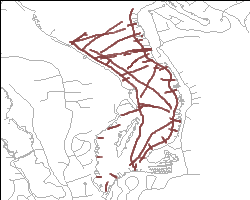
An AWK script was used to extract the navigation, bathymetry, and temperature information recorded in each individual GPS data file for each day of data acqusition.
AWK script "awkhold":
BEGIN {
FS = ","
}
{
FS = ","
ARGC = 2
depth = -9999
temp = -9999
if ($1=="$GPRMC")
	{
	utctime = $2
	latdeg = substr($4,1,2)
	latmin = substr($4,3,6)
	declat = latdeg + (latmin/60)
	londeg = substr($6,1,3)
	lonmin = substr($6,4,6)
	declon = -1 * (londeg + (lonmin/60))
	if (NR==1) {
		holddepth = -9999
		holdtemp = -9999
		}
	else {
		printf("%s, %9.6f, %9.6f, %5.1f, %5.1f, %s\n", holdutctime, >holddeclon, holddeclat, holddepth, holdtemp, ARGV[2])
	}
	holdutctime = utctime
	holddeclon = declon
	holddeclat = declat
	holddepth = -9999
	holdtemp = -9999
	}
if ($1=="$SDDPT")
	{
	depthreal = $2
	holddepth = depthreal
	}
if ($1=="$SDMTW")
	{
	tempreal = $2
	holdtemp = tempreal
	}
}
END {
printf("%s, %9.6f, %9.6f, %5.1f, %5.1f, %s\n", holdutctime, holddeclon, >holddeclat, holddepth, holdtemp, ARGV[2])
}
This AWK script was initialized by "dogps" - shell script run under CYGWIN v. 1.5.1 (UNIX like environment that runs under Windows). This is the script used for the May 12 data collection:
files=`ls *.gps | cut -d. -f1`
for file in $files
do
	awk -f awkhold $file.gps $file >> day1gps.txt
done
The script not only parses the GPS navigation, but concatenates the results into a single file. This script was repeated for day 2 and day 3 (May 13 and May 14 respectively) with the output directed to day2gps.txt and day3gps.txt.