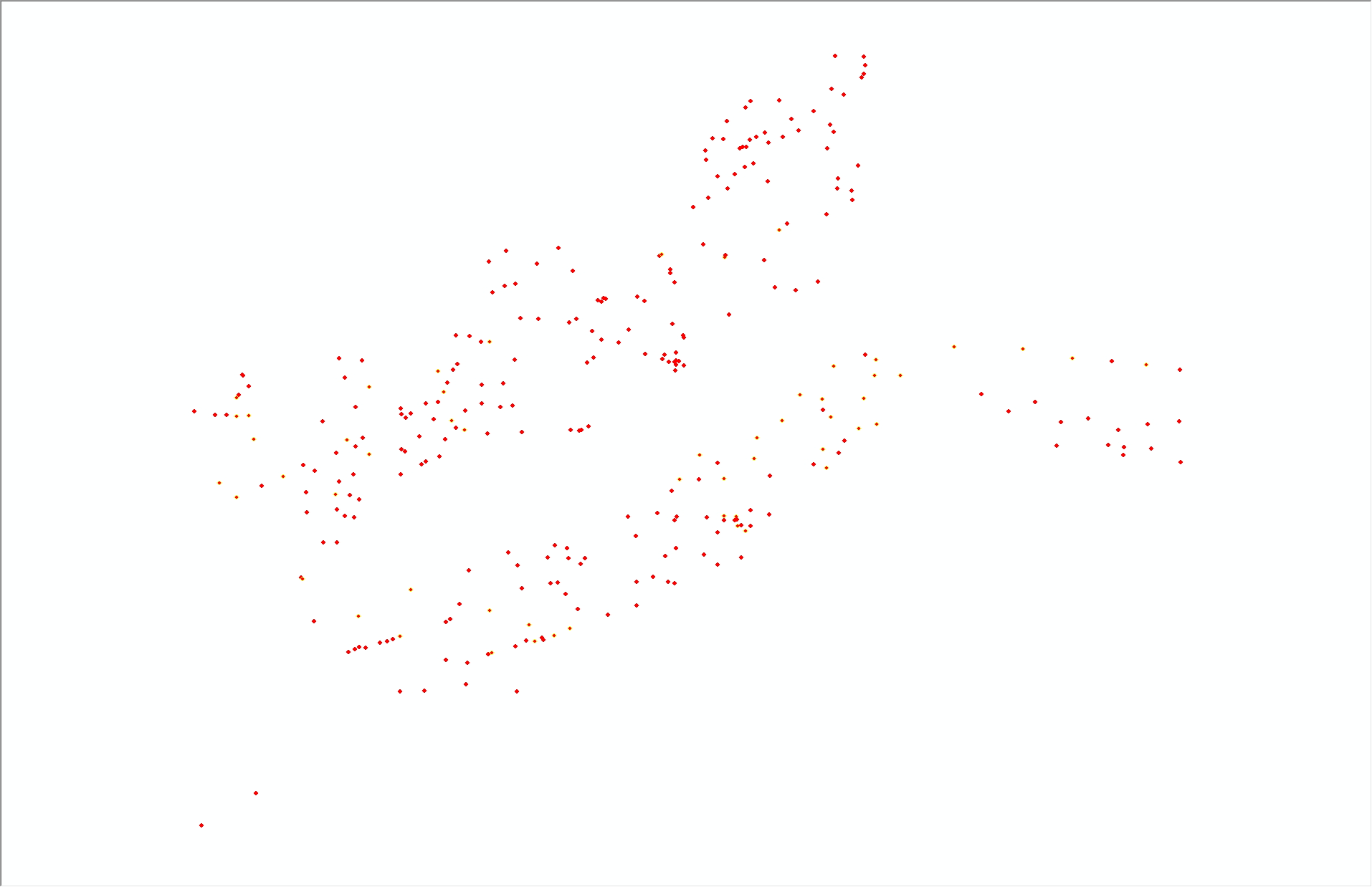
Locations and analysis of sediment samples collected by the U.S. Geological Survey offshore of Massachusetts in Buzzards Bay and Vineyard Sound in September 2010 on the RV Connecticut (BBVS_SedimentSamples.shp)

Metadata also available as - [Outline] - [Parseable text] - [XML]

Frequently anticipated questions:


What does this data set describe?

Title:
Locations and analysis of sediment samples collected by the U.S. Geological Survey offshore of Massachusetts in Buzzards Bay and Vineyard Sound in September 2010 on the RV Connecticut (BBVS_SedimentSamples.shp)
Abstract:
These data were collected under a cooperative agreement with the Massachusetts Office of Coastal Zone Management (CZM) and the U.S. Geological Survey (USGS), Coastal and Marine Geology Program. The primary objective of this program, initiated in 2003, is to develop regional geologic framework information for the management of coastal and marine resources. Accurate data and maps of sea-floor geology are important first steps toward protecting fish habitat, delineating marine resources, and assessing environmental changes due to natural or human effects. The project is focused on the inshore waters (5-30 meters deep) of Massachusetts. Data collected for the mapping cooperative have been released in a series of USGS Open-File Reports (http://woodshole.er.usgs.gov/project-pages/coastal_mass/html/current_map.html). This spatial dataset is from the study area located in Buzzards Bay and Vineyard Sound Massachusetts, and consists of ground-validation data which include the spatial extent of sea-floor sediment sample analyses, the location of sea-floor bottom photographs, and the tracklines along which sea-floor video was collected. These ground-validation (or ground-truth) data accompany a suite of high-resolution geophysical data, including swath bathymetry, sidescan-sonar backscatter intensity, and seismic-reflection data that were released in USGS Open File Reports 2012-1002 and 2012-1006. The sea-floor sampling data were collected during USGS survey 2010-005-FA in 2010 and cover more than 750 square kilometers of the inner continental shelf where the geophysical data were collected in 2009 and 2010.
  1. How might this data set be cited?
    U.S. Geological Survey, 2015, Locations and analysis of sediment samples collected by the U.S. Geological Survey offshore of Massachusetts in Buzzards Bay and Vineyard Sound in September 2010 on the RV Connecticut (BBVS_SedimentSamples.shp): Open-File Report 2014-1221, U.S. Geological Survey, Coastal and Marine Geology Program, Woods Hole Coastal and Marine Science Center, Woods Hole, Massachusetts.

    Online Links:

    This is part of the following larger work.

    Ackerman, Seth D., Pappal, Adrienne L., Huntley, Emily C., Blackwood, Dann S., and Schwab, William C., 2015, Geological Sampling Data and Benthic Biota Classification: Buzzards Bay and Vineyard Sound, Massachusetts: Open-File Report 2014-1221, U.S. Geological Survey, Reston, Virginia.

    Online Links:

    Other_Citation_Details:
    Suggested citation: Ackerman, S.D., Pappal, A.L., Huntley, E.C., Blackwood, D.S., and Schwab, W.C., 2015, Geological sampling data and benthic biota classification—Buzzards Bay and Vineyard Sound, Massachusetts: U.S. Geological Survey Open-File Report 2014–1221, 30 p., https://doi.org/10.3133/ofr20141221.
  2. What geographic area does the data set cover?
    West_Bounding_Coordinate: -71.096530
    East_Bounding_Coordinate: -70.457302
    North_Bounding_Coordinate: 41.649430
    South_Bounding_Coordinate: 41.267740
  3. What does it look like?
    https://pubs.usgs.gov/of/2014/1221/GIS/browse_jpg/big/BBVS_SedimentSamples.jpg (JPEG)
    Thumbnail image of sediment sample locations
  4. Does the data set describe conditions during a particular time period?
    Beginning_Date: 09-Sep-2010
    Ending_Date: 14-Sep-2010
    Currentness_Reference:
    ground condition
  5. What is the general form of this data set?
    Geospatial_Data_Presentation_Form: vector digital data
  6. How does the data set represent geographic features?
    1. How are geographic features stored in the data set?
      This is a Vector data set. It contains the following vector data types (SDTS terminology):
      • Entity point (302)
    2. What coordinate system is used to represent geographic features?
      Horizontal positions are specified in geographic coordinates, that is, latitude and longitude. Latitudes are given to the nearest 0.000001. Longitudes are given to the nearest 0.000001. Latitude and longitude values are specified in Decimal degrees. The horizontal datum used is D_WGS_1984.
      The ellipsoid used is WGS_1984.
      The semi-major axis of the ellipsoid used is 6378137.000000.
      The flattening of the ellipsoid used is 1/298.257224.
      Vertical_Coordinate_System_Definition:
      Depth_System_Definition:
      Depth_Datum_Name: mean lower low water
      Depth_Resolution: 0.1
      Depth_Distance_Units: meters
      Depth_Encoding_Method: Implicit coordinate
  7. How does the data set describe geographic features?
    BBVS_SedimentSamples
    point location of sediment samples or visual seafloor observations (Source: U.S. Geological Survey)
    FID
    Internal feature number. (Source: Esri) Sequential unique whole numbers that are automatically generated.
    Shape
    Feature geometry. (Source: Esri) Coordinates defining the features.
    DB_ID
    Unique identification number generated in the sedimentation laboratory of the USGS's Woods Hole Coastal and Marine Science Center. For samples analyzed after 1980 this identifier consists of 2 characters and 3 numerics (e.g. AS114). For samples analyzed prior to 1980, this identifier consists of 4 numerics possibly followed by as many as 2 characters. (Source: USGS East Coast Sediment Texture Database data dictionary) Character string of width 254
    FIELD_NO
    Sample name or number as assigned in the field by the Chief Scientist (Source: USGS East Coast Sediment Texture Database data dictionary) Character string of width 254
    PROJECT
    Name of project or project number under which samples were taken or data generated; sometimes project name indicates a more specific area (COASTAL MASS = Coastal Massachusetts) (Source: USGS East Coast Sediment Texture Database data dictionary) Character string of width 254
    CRUISE_ID
    Name or number of cruise on which sample collected. Historically cruise identifiers were a combination of ship name, year of cruise and cruise leg. In more recent years, cruise identifier is a sequential serial number assigned to field activities within a specific year (in the format YYXXX where YY is the year and XXX is the cruise number within that year) (Source: USGS East Coast Sediment Texture Database data dictionary) Character string of width 254
    CONTACT
    Name of Principal Investigator or Chief Scientist responsible for data collection (usually first initial and last name) when available. (Source: USGS East Coast Sediment Texture Database data dictionary) Character string of width 254
    AREA
    General geographic area of data collection. Name is general enough to easily locate area on a state map. (Source: USGS East Coast Sediment Texture Database data dictionary) Character string of width 254
    LATITUDE
    Latitude coordinate, in decimal-degrees, of sample location. South latitude recorded as negative values. (Source: USGS East Coast Sediment Texture Database data dictionary)
    Range of values
    Minimum:41.267740
    Maximum:41.649430
    Units:Decimal degrees
    Resolution:0.000001
    LONGITUDE
    Longitude coordinate, in decimal degrees, of sample location. West longitude is recorded as negative values. (Source: USGS East Coast Sediment Texture Database data dictionary)
    Range of values
    Minimum:-71.096530
    Maximum:-70.457302
    Units:Decimal degrees
    Resolution:0.000001
    DEPTH_M
    Depth in meters extracted from the recent USGS bathymetry data released on USGS Open File Reports 2012-1002 (Ackerman and others, 2013) and 2012-1006 (Andrews and others, 2013); Hydrographic data from Quicks Hole NOAA NOS survey H11076 (for sample sites 216, 217, 218 and 219); and the NOAA NGDC's 3 arc-second U.S. Coastal Relief Model data (for sample sites 174 and 175). (Source: U.S. Geological Survey)
    Range of values
    Minimum:7.5
    Maximum:41.7
    Units:meters
    T_DEPTH
    Top depth of the sample below the sediment-water interface, in centimeters. No data value -9999. (Source: USGS East Coast Sediment Texture Database data dictionary)
    Range of values
    Minimum:0
    Maximum:0
    Units:centimeters
    B_DEPTH
    Bottom depth of the sample below the sediment-water interface, in centimeters. No data value -9999. (Source: USGS East Coast Sediment Texture Database data dictionary)
    Range of values
    Minimum:2
    Maximum:2
    Units:centimeters
    DEVICE
    Device used to collect the sample. (Source: USGS East Coast Sediment Texture Database data dictionary)
    ValueDefinition
    BIG SEABOSS GRABsample collected with Van Veen grab sampler on the BIG SEABOSS
    MONTH_COLL
    Calendar month sample collected based on time in UTC. (Source: USGS East Coast Sediment Texture Database data dictionary)
    Range of values
    Minimum:9
    Maximum:9
    DAY_COLL
    Calendar day sample collected based on time in UTC. (Source: USGS East Coast Sediment Texture Database data dictionary)
    Range of values
    Minimum:9
    Maximum:13
    YEAR_COLL
    Calendar year sample collected based on time in UTC. (Source: USGS East Coast Sediment Texture Database data dictionary)
    Range of values
    Minimum:2010
    Maximum:2010
    MONTH_ANAL
    Calendar month sample analyzed. (Source: USGS East Coast Sediment Texture Database data dictionary)
    Range of values
    Minimum:12
    Maximum:12
    DAY_ANAL
    Calendar day sample analyzed. (Source: USGS East Coast Sediment Texture Database data dictionary)
    Range of values
    Minimum:15
    Maximum:15
    YEAR_ANAL
    Calendar year sample analyzed. (Source: USGS East Coast Sediment Texture Database data dictionary)
    Range of values
    Minimum:2010
    Maximum:2010
    WEIGHT
    Weight of dry sample in grams. (Source: USGS East Coast Sediment Texture Database data dictionary)
    Range of values
    Minimum:16.1516
    Maximum:461.7900
    Units:grams
    Resolution:0.0001
    GRAVEL_PCT
    Gravel content in percent dry weight of the sample (particles with nominal diameters greater than 2 mm; -1 Phi and larger). No data value -9999. (Source: USGS East Coast Sediment Texture Database data dictionary)
    Range of values
    Minimum:0
    Maximum:83.75
    Units:percent
    Resolution:0.01
    SAND_PCT
    Sand content in percent dry weight of the sample (particles with nominal diameters less than 2 mm, but greater than or equal to 0.0625 mm; 0 Phi through 4 Phi). No data value -9999. (Source: USGS East Coast Sediment Texture Database data dictionary)
    Range of values
    Minimum:2.55
    Maximum:99.88
    Units:percent
    Resolution:0.01
    SILT_PCT
    Silt content in percent dry weight of the sample (particles with nominal diameters less than 0.0625 mm, but greater than or equal to 0.004 mm; 5 Phi through 8 Phi, inclusive). No data value -9999. (Source: USGS East Coast Sediment Texture Database data dictionary)
    Range of values
    Minimum:0.03
    Maximum:73.12
    Units:percent
    Resolution:0.01
    CLAY_PCT
    Clay content in percent dry weight of the sample (particles with nominal diameters less than 0.004 mm; 9 Phi and smaller). No data value -9999. (Source: USGS East Coast Sediment Texture Database data dictionary)
    Range of values
    Minimum:0
    Maximum:33.36
    Units:percent
    Resolution:0.01
    CLASSIFICA
    Sediment Classification - Sediment description based on a rigorous definition, usually Shepard (1954) as modified by Schlee (1973) and Poppe and others (2005). (Source: USGS East Coast Sediment Texture Database data dictionary)
    ValueDefinition
    CLAYEY SILTSediment whose main phase is silt, but with significant clay.
    GRAVELSediment whose main phase (equal to or greater than 50 percent) is greater than 2 mm.
    GRAVELLY SEDIMENTSediment whose phase is equal to or greater than 10 percent, but less than 50 percent gravel, but with significant other sediment.
    MUDSediment whose main phase is less than 0.062 mm based on visual observation
    SANDSediment whose main phase is less than 2 mm, but greater than or equal to 0.062 mm.
    SAND SILT CLAYSediment with significant (over 20 percent) sand, silt, and clay.
    SANDY SILTSediment whose main phase is silt, but with significant sand.
    SILTY SANDSediment whose main phase is clay, but with significant silt.
    MEDIAN
    Middle point in the grain size distribution in phi units. No data value -9999. (Source: USGS East Coast Sediment Texture Database data dictionary)
    Range of values
    Minimum:-5.32
    Maximum:7.36
    Units:phi
    Resolution:0.01
    MEAN
    Average value in the grain size distribution in phi units. No data value -9999. (Source: USGS East Coast Sediment Texture Database data dictionary)
    Range of values
    Minimum:-3.91
    Maximum:7.19
    Units:phi
    Resolution:0.01
    STDEV_
    Standard deviation (root mean square of the deviations) of the grain size distribution in phi units (sorting). No data value -9999. (Source: USGS East Coast Sediment Texture Database data dictionary)
    Range of values
    Minimum:0.38
    Maximum:3.45
    Units:phi
    Resolution:0.01
    SKEWNESS
    Skewness (deviation from symmetrical form) of the grain size distribution in phi units. No data value -9999. (Source: USGS East Coast Sediment Texture Database data dictionary)
    Range of values
    Minimum:-0.57
    Maximum:4.81
    Units:unitless
    Resolution:0.01
    KURTOSIS
    Kurtosis (degree of curvature near the mode) of the grain size distribution in phi units. No data value -9999. (Source: USGS East Coast Sediment Texture Database data dictionary)
    Range of values
    Minimum:-1.81
    Maximum:47.04
    Units:unitless
    Resolution:0.01
    PHIm5
    -5 Phi - Weight percent of the sample in the -5 Phi fraction and larger (nominal diameter of particles greater than or equal to 32 mm); very coarse pebbles, cobbles, and boulders. No data value -9999. (Source: USGS East Coast Sediment Texture Database data dictionary)
    Range of values
    Minimum:0
    Maximum:73.13
    Units:percent
    Resolution:0.01
    PHIm4
    -4 Phi - Weight percent of the sample in the -4 Phi fraction (nominal diameter of particles greater than or equal to 16 mm, but less than 32 mm); coarse pebbles. No data value -9999. (Source: USGS East Coast Sediment Texture Database data dictionary)
    Range of values
    Minimum:0
    Maximum:24.07
    Units:percent
    Resolution:0.01
    PHIm3
    -3 Phi - Weight percent of the sample in the -3 Phi fraction (nominal diameter of particles greater than or equal to 8 mm, but less than 16 mm); medium pebbles. No data value -9999. (Source: USGS East Coast Sediment Texture Database data dictionary)
    Range of values
    Minimum:0
    Maximum:12.33
    Units:percent
    Resolution:0.01
    PHIm2
    -2 Phi - Weight percent of the sample in the -2 Phi fraction (nominal diameter of particles greater than or equal to 4 mm, but less than 8 mm); fine pebbles. No data value -9999. (Source: USGS East Coast Sediment Texture Database data dictionary)
    Range of values
    Minimum:0
    Maximum:12.66
    Units:percent
    Resolution:0.01
    PHIm1
    -1 Phi - Weight percent of the sample in the -1 Phi fraction (nominal diameter of particles greater than or equal to 2 mm, but less than 4 mm); very fine pebbles (granules). No data value -9999. (Source: USGS East Coast Sediment Texture Database data dictionary)
    Range of values
    Minimum:0
    Maximum:24.35
    Units:percent
    Resolution:0.01
    PHI_0
    0 Phi - Weight percent of the sample in the 0 Phi fraction (nominal diameters of particles greater than or equal to 1 mm, but less than 2 mm); very coarse sand. No data value -9999. (Source: USGS East Coast Sediment Texture Database data dictionary)
    Range of values
    Minimum:0.01
    Maximum:44.03
    Units:percent
    Resolution:0.01
    PHI_1
    1 Phi - Weight percent of the sample in the 1 Phi fraction (nominal diameter of particles greater than or equal to 0.5 mm, but less than 1 mm); coarse sand. No data value -9999. (Source: USGS East Coast Sediment Texture Database data dictionary)
    Range of values
    Minimum:0.06
    Maximum:83.70
    Units:percent
    Resolution:0.01
    PHI_2
    2 Phi - Weight percent of the sample in the 2 Phi fraction (nominal diameter of particles greater than or equal to 0.25 mm, but less than 0.5 mm); medium sand. No data value -9999. (Source: USGS East Coast Sediment Texture Database data dictionary)
    Range of values
    Minimum:0.14
    Maximum:88.16
    Units:percent
    Resolution:0.01
    PHI_3
    3 Phi - Weight percent of the sample in the 3 Phi fraction (nominal diameter of particles greater than or equal to 0.125 mm, but less than 0.25 mm); fine sand. No data value -9999. (Source: USGS East Coast Sediment Texture Database data dictionary)
    Range of values
    Minimum:0.06
    Maximum:79.16
    Units:percent
    Resolution:0.01
    PHI_4
    4 Phi - Weight percent of the sample in the 4 Phi fraction (nominal diameters of particles greater than or equal to .0625 mm, but less than 0.125 mm); very fine sand. No data value -9999. (Source: USGS East Coast Sediment Texture Database data dictionary)
    Range of values
    Minimum:0.01
    Maximum:74.45
    Units:percent
    Resolution:0.01
    PHI_5
    5 Phi - Weight percent of the sample in the 5 Phi fraction (nominal diameter of particles greater than or equal to 0.031 mm, but less than 0.0625 mm); coarse silt. No data value -9999. (Source: USGS East Coast Sediment Texture Database data dictionary)
    Range of values
    Minimum:0
    Maximum:15.75
    Units:percent
    Resolution:0.01
    PHI_6
    6 Phi - Weight percent of the sample in the 6 Phi fraction (nominal diameter of particles greater than or equal to 0.016 mm, but less than 0.031 mm); medium silt. No data value -9999. (Source: USGS East Coast Sediment Texture Database data dictionary)
    Range of values
    Minimum:0.01
    Maximum:23.51
    Units:percent
    Resolution:0.01
    PHI_7
    7 Phi - Weight percent of the sample in the 7 Phi fraction (nominal diameter of particles greater than or equal to 0.008 mm, but less than 0.016 mm); fine silt. No data value -9999. (Source: USGS East Coast Sediment Texture Database data dictionary)
    Range of values
    Minimum:0.01
    Maximum:28.5
    Units:percent
    Resolution:0.01
    PHI_8
    8 Phi - Weight percent of the sample in the 8 Phi fraction (nominal diameter of particles greater than or equal to 0.004 mm, but less than 0.008 mm); very fine silt. No data value -9999. (Source: USGS East Coast Sediment Texture Database data dictionary)
    Range of values
    Minimum:0
    Maximum:25.79
    Units:percent
    Resolution:0.01
    PHI_9
    9 Phi - Weight percent of the sample in the 9 Phi fraction (nominal diameter of particles greater than or equal to 0.002 mm, but less than 0.004 mm); coarse clay. No data value -9999. (Source: USGS East Coast Sediment Texture Database data dictionary)
    Range of values
    Minimum:0
    Maximum:19.23
    Units:percent
    Resolution:0.01
    PHI_10
    10 Phi - Weight percent of the sample in the 10 Phi fraction (nominal diameter of particles greater than or equal to 0.001 mm, but less than 0.002 mm); medium clay. No data value -9999. (Source: USGS East Coast Sediment Texture Database data dictionary)
    Range of values
    Minimum:0
    Maximum:9.97
    Units:percent
    Resolution:0.01
    PHI_11
    11 Phi - Weight percent of the sample in the 11 Phi fraction and smaller (nominal diameter of particles less than 0.001 mm); fine clay. No data value -9999. (Source: USGS East Coast Sediment Texture Database data dictionary)
    Range of values
    Minimum:0
    Maximum:4.16
    Units:percent
    Resolution:0.01
    ANALYST
    Name (usually first initial and last name) of person who performed the grain size or physical properties analysis (Source: USGS East Coast Sediment Texture Database data dictionary) Character string of width 254
    ANAL_COMM
    Comments on analyses - Any further information about sediment analysis for all or specific parameters in this table (Source: USGS East Coast Sediment Texture Database data dictionary) Character string of width 254
    LITHOLOGY
    General lithologic description of sample (Source: USGS East Coast Sediment Texture Database data dictionary) Character string of width 254
    COMMENTS
    Comments on sample collection or lithology (Source: USGS East Coast Sediment Texture Database data dictionary) Character string of width 254
    Entity_and_Attribute_Overview:
    The Attribute Definition Source for most of these attributes is the USGS East Coast Sediment Texture Database data dictionary which can be found in USGS Open File Report 2005-1001 (https://pubs.usgs.gov/of/2005/1001/) - see the updated shapefile: ECSTDB2011.SHP: U.S. Geological Survey East Coast Sediment Texture Database (2011)
    Entity_and_Attribute_Detail_Citation:
    USGS Open File Report 2005-1001 (https://pubs.usgs.gov/of/2005/1001/)

Who produced the data set?

  1. Who are the originators of the data set? (may include formal authors, digital compilers, and editors)
    • U.S. Geological Survey
  2. Who also contributed to the data set?
  3. To whom should users address questions about the data?
    Seth Ackerman
    U.S. Geological Survey
    Geologist
    384 Woods Hole Rd.
    Woods Hole, MA
    USA

    508-548-8700 x2315 (voice)
    508-457-2310 (FAX)
    sackerman@usgs.gov

Why was the data set created?

This data set includes the locations, identifiers, grain-size data and/or textural descriptions of surficial sediments collected at 301 stations. The sediments were collected with a modified Van Veen grab on the large SEABed Observation and Sampling System (SEABOSS, SEABOSS Mark II configuration) during USGS survey 2010-005-FA, conducted September 9-14, 2010 aboard the R/V Connecticut offshore Massachusetts in Buzzards Bay and Vineyard Sound. This data set was collected to ground-truth (verify) the acoustic data sets that were acquired during NOAA hydrographic survey H11319 (2004) and USGS geophysical surveys 09002 (2009) and 10004 (2010). Bottom photographs and videos were also taken at each station occupied by the SEABOSS (see shapefiles BBVS_BottomPhotos_wBio.shp and BBVS_SeabossTrackline.shp) Samples were analyzed in the sediment laboratory at the USGS Woods Hole Coastal and Marine Science Center.

How was the data set created?

  1. From what previous works were the data drawn?
  2. How were the data generated, processed, and modified?
    Date: Sep-2010 (process 1 of 6)
    Three hundred and one target stations were occupied aboard the R/V Connecticut (USGS survey 2010-005-FA) with the large SEABOSS (Blackwood and Parolski, 2001) that was equipped with a Van Veen grab sampler, a digital still camera, and a video camera. Physical sediment samples were collected at 246 stations, and an additional 55 stations were "sampled" with the photographs and video where sediment samples could not be collected. Those stations can be identified by the note in the comment field of the shapefile attribute table stating that the sediment classification is based on a visual observation. The location for these visual observation stations is typically the location of the last photograph or the end of the seafloor video drift. Person who carried out this activity:
    Seth Ackerman
    U.S. Geological Survey
    Geologists
    384 Woods Hole Road
    Woods Hole, MA
    USA

    (508) 548-8700 x2315 (voice)
    (508) 457-2310 (FAX)
    sackerman@usgs.gov
    Data sources produced in this process:
    • bagged sediment samples or notes for visual observations
    Date: Dec-2010 (process 2 of 6)
    Samples were analyzed in the sediment laboratory at the USGS Woods Hole Coastal and Marine Science Center. Coarse fraction determined by sieve; fine fraction determined by Coulter Counter. See Poppe, Williams, and Paskevich (2005) for analytical specifics. MS Excel file (XLS) saved as Comma Separated Value file (CSV). Person who carried out this activity:
    Larry Poppe
    U.S. Geological Survey
    Geologist
    384 Woods Hole Road
    Woods Hole, MA
    USA

    (508) 548-8700 x2314 (voice)
    (508) 457-2310 (FAX)
    lpoppe@usgs.gov
    Data sources used in this process:
    • bagged sediment samples
    Data sources produced in this process:
    • bs12.xls
    • bs12.csv
    Date: Aug-2013 (process 3 of 6)
    The location and depth data were checked and modified as necessary, and stations where no physical sample was collected were added to the data analyses. A final dataset of sediment samples was re-submitted to the sediment lab for their database. Person who carried out this activity:
    Seth Ackerman
    U.S. Geological Survey
    Geologist
    384 Woods Hole Rd.
    Woods Hole, MA
    USA

    508-548-8700 x2315 (voice)
    508-457-2310 (FAX)
    sackerman@usgs.gov
    Data sources used in this process:
    • wb1.csv
    Data sources produced in this process:
    • 10005_tokate_5-2-13_SDA_edits_FINAL_v1_ECH.csv
    • BBVS_SedimentSamples.csv
    Date: Aug-2013 (process 4 of 6)
    In ArcCatalog (version 9.3), the ASCII comma-delimited file (BBVS_SedimentSamples.csv) was converted to a point feature class by right-clicking on the comma separated value text file -- Create Feature Class -- from XY table using the defined geographic coordinate system (Decimal_Degrees_WGS84.prj). [output file: BBVS_SedimentSamples.shp] Person who carried out this activity:
    Seth Ackerman
    U.S. Geological Survey
    Geologist
    384 Woods Hole Rd.
    Woods Hole, MA
    USA

    508-548-8700 x2315 (voice)
    508-457-2310 (FAX)
    sackerman@usgs.gov
    Data sources used in this process:
    • BBVS_SedimentSamples.csv
    Data sources produced in this process:
    • BBVS_SedimentSamples.shp
    • BBVS_SedimentSamples.prj
    Date: Feb-2014 (process 5 of 6)
    In ArcMap (version 10.1), several fields containing null values (MODE1CLASS, MODE1FREQ, MODE2CLASS, MODE2FREQ, MODE3CLASS, MODE3FREQ and NMODES) and the field GROUP were deleted from the shapefile. These fields remain in the CSV file that contain the full table of sediment analyses as provided by the sediment lab. Person who carried out this activity:
    Seth Ackerman
    U.S. Geological Survey
    Geologist
    384 Woods Hole Rd.
    Woods Hole, MA
    USA

    508-548-8700 x2315 (voice)
    508-457-2310 (FAX)
    sackerman@usgs.gov
    Data sources used in this process:
    • BBVS_SedimentSamples.shp
    Data sources produced in this process:
    • BBVS_SedimentSamples.shp
    Date: 25-Jul-2025 (process 6 of 6)
    The following edits were performed on this file: Modified the title to move filename to end of title; added the DOI link as the first link in the metadata file; added the suggested citation to the other citation details; added the DOI link as the first link in the larger work citation; fixed the publication date for both the datasets and larger work citation; removed Esri tags; rename “General” to “None” thesaurus name; added USGS Thesaurus terms; removed invalid ISO 19115 Topic Category terms; changed the NOAA Coastal Relief pub date from 2001-2003 to 2003; fixed all errors; replaced the distribution liability with an approved FSP statement; added a generic email with contact instructions for the metadata contact; added the metadata unique identifier (PID) in the thesaurus section; updated the metadata date. (20250725) Person who carried out this activity:
    U.S. Geological Survey
    Attn: VeeAnn A. Cross
    Marine Geologist
    384 Woods Hole Rd.
    Woods Hole, MA
    USA

    (508) 548-8700 x2251 (voice)
    (508) 457-2310 (FAX)
    vatnipp@usgs.gov
  3. What similar or related data should the user be aware of?
    Blackwood, D., and Parolski, K., 2001, Seabed observation and sampling system: Sea Technology v. 42, no. 2, p. 39-43.

    Poppe, L.J., Williams, S.J., and Paskevich, V.F., 2005, USGS East-Coast Sediment Analysis: Procedures, Database, and GIS Data: Open-File Report 2005-1001, U.S. Geological Survey, Reston, VA.

    Online Links:

    Shepard, F.P., 1954, Nomenclature based on sand-silt-clay ratios: Journal Sedimentary Petrology 24 (3), Society of Economic Paleontologists and Mineralogists, Tulsa, OK.

    Online Links:

    Ackerman, Seth D., Andrews, Brian D., Foster, David S., Baldwin, Wayne E., and Schwab, William C., 2013, High-resolution geophysical data from the inner continental shelf - Buzzards Bay, Massachusetts: Open-File Report 2012-1002, U.S. Geological Survey, Reston, VA.

    Online Links:

    Andrews, Brian D., Ackerman, Seth D., Baldwin, Wayne E., Foster, David S., and Schwab, William C., 2013, High-Resolution geophysical data from the inner continental shelf at Vineyard Sound, Massachusetts: Open-File Report 2012-1006, U.S. Geological Survey, Reston, VA.

    Online Links:

    Poppe, Larry J., Ackerman, Seth D., Foster, David S., Blackwood, Dann S., Butman, Bradford, Moser, Marc S., and Stewart, Helen F., 2007, Sea-floor character and sedimentary processes of Quicks Hole, Elizabeth Islands, Massachusetts: Open-File Report 2006-1357, U.S. Geological Survey, Reston, VA.

    Online Links:

    National Oceanic and Atmospheric Administration (NOAA) National Geophysical Data Center (NGDC), 2003, U.S. Coastal Relief Model, Volume 1: NOAA National Geophysical Data Center, Boulder, CO.

    Online Links:


How reliable are the data; what problems remain in the data set?

  1. How well have the observations been checked?
    All attributes were checked in a consistent manner
  2. How accurate are the geographic locations?
    Navigation for survey 2010-005-FA used Differential Global Positioning System (GPS). The recorded position of each sediment sample is actually the position of the GPS antenna on the survey vessel, not the SEABOSS sampler. The SEABOSS was deployed approximately 5 meters astern of the GPS antenna off the ship's A-frame on the stern of the ship. No layback or offset was applied to the recorded position. In addition to the +/-5 meter offset the SEABOSS may additionally drift away from the survey vessel when deployed to the seafloor. Based on the various sources for horizontal offsets, a conservative estimate of the horizontal accuracy of the sediment sample is 20-30 meters.
  3. How accurate are the heights or depths?
    The depths recorded for each sample were derived from the final bathymetry grids from the Buzzards Bay and Vineyard Sound survey areas (depths for stations 174, 175, 216, 217, 218, and 219, which were located outside the bathymetry coverage from Buzzards Bay and Vineyard Sound, were determined from other sources including the Quicks Hole bathymetry dataset and the NOAA Coastal Relief Model). See the original datasets of those bathymetry data (links in the cross-references section) to determine the vertical accuracy of these depth values.
  4. Where are the gaps in the data? What is missing?
    This dataset includes data for all stations that were occupied with the SEABOSS during USGS survey 2010-005-FA aboard the R/V Connecticut. Three-hundred and one stations were occupied with the SEABOSS in the Buzzards Bay and Vineyard Sound survey area; however sediment samples were only collected at 246 stations where collecting a sample would not damage the sampling equipment (e.g. no samples were collected in areas with cobble, boulder or rocky seabed, as identified in real-time by video and photos). At nine sites (Stations 41, 47, 173, 195, 206, 208, 242, 244, and 247) samples were attempted one or more times in what appeared in the real-time video as sand or mud, but no sample was successfully collected; these sites have no sediment lab analyses but are classified as sand or mud and it is noted in the comments field of the table that this classification is based on the visual observation of the seafloor by USGS geologists. At two sites (Stations 154 and 166) the sampler was held open by a cobble-size sediment and therefore only the single rock was recovered; the cobbles were classified by the sediment lab as gravel, with a phi sizes of -4 and -6, respectively, although it is important to note that this was an incomplete sample and therefore there was no real sediment lab analyses performed for these sites. Two other sites (Stations 174 and 175) were located outside the study area and were collected to fill a data gap for another project at the WHCMSC). Stations 216, 217, 218, and 219 also fell slightly outside the area covered by swath bathymetry but supplement the USGS-CZM Massachusetts Seafloor Mapping Project. At site 218, a deeper scoop (2 -5cm) from within same Van Veen grab was taken and analyzed by the sediment lab just because we were curious; this analysis (called sample 218-2) is not included with this shapefile.
    Note that the term 'sediment samples' used herein may be used to describe samples as well as SEABOSS stations where the bottom type was determined by visual observation and no physical sediment sample was collected.
    This shapefile represents a simplified version of the full sediment lab analyses. The CSV file contains the complete sediment lab analyses.
  5. How consistent are the relationships among the observations, including topology?
    No additional checks for topological consistency were performed on this data. Gaps in sequential sample numbers may exist, as physical samples are sometimes not collected at all stations.

How can someone get a copy of the data set?

Are there legal restrictions on access or use of the data?
Access_Constraints None
Use_Constraints Public domain data from the U.S. Government are freely redistributable with proper metadata and source attribution. Please recognize the U.S. Geological Survey as the source of this information.
  1. Who distributes the data set? (Distributor 1 of 2)
    Seth Ackerman
    U.S. Geological Survey
    Geologist
    384 Woods Hole Rd.
    Woods Hole, MA
    USA

    508-548-8700 x2315 (voice)
    508-457-2310 (FAX)
    sackerman@usgs.gov
  2. What's the catalog number I need to order this data set? Downloadable Data
  3. What legal disclaimers am I supposed to read?
    Unless otherwise stated, all data, metadata and related materials are considered to satisfy the quality standards relative to the purpose for which the data were collected. Although these data and associated metadata have been reviewed for accuracy and completeness and approved for release by the U.S. Geological Survey (USGS), no warranty expressed or implied is made regarding the display or utility of the data for other purposes, nor on all computer systems, nor shall the act of distribution constitute any such warranty.
  4. How can I download or order the data?
  5. What hardware or software do I need in order to use the data set?
    These data are available in Environmental Systems Research Institute (Esri) shapefile format. To utilize these data, the user must have software capable of viewing Esri shapefiles. The shapefile is also distributed in compressed format as one zip file. To utilize these data, the user must be able to uncompress the zip file.

  1. Who distributes the data set? (Distributor 2 of 2)
    Seth Ackerman
    U.S. Geological Survey
    Geologist
    384 Woods Hole Rd.
    Woods Hole, MA
    USA

    508-548-8700 x2315 (voice)
    508-457-2310 (FAX)
    sackerman@usgs.gov
  2. What's the catalog number I need to order this data set? Downloadable Data
  3. What legal disclaimers am I supposed to read?
    Neither the U.S. Government, the Department of the Interior, nor the USGS, nor any of their employees, contractors, or subcontractors, make any warranty, express or implied, nor assume any legal liability or responsibility for the accuracy, completeness, or usefulness of any information, apparatus, product, or process disclosed, nor represent that its use would not infringe on privately owned rights. The act of distribution shall not constitute any such warranty, and no responsibility is assumed by the USGS in the use of these data or related materials. Any use of trade, product, or firm names is for descriptive purposes only and does not imply endorsement by the U.S. Government.
  4. How can I download or order the data?
  5. What hardware or software do I need in order to use the data set?
    These data are available as a generic ASCII formatted data file. The user must have a software program capable of reading the comma-delimited data file.

Who wrote the metadata?

Dates:
Last modified: 25-Jul-2025
Metadata author:
Seth Ackerman
U.S. Geological Survey
Geologist
384 Woods Hole Rd.
Woods Hole, MA
USA

508-548-8700 x2315 (voice)
508-457-2310 (FAX)
whsc_data_contact@usgs.gov
Contact_Instructions:
The metadata contact email address is a generic address in the event the person is no longer with the U.S. Geological Survey.
Metadata standard:
FGDC Content Standards for Digital Geospatial Metadata (FGDC-STD-001-1998)

This page is <https://cmgds.marine.usgs.gov/catalog/whcmsc/open_file_report/ofr2014-1221/BBVS_SedimentSamples_meta.faq.html>
Generated by mp version 2.9.51 on Mon Jul 28 09:52:39 2025