AKA: CSF20
Other ID: none
Status: Completed
Organization(s): USGS, Pacific Coastal and Marine Science Center
Funding Program(s): Other (Other), Sediment Transport in Coastal Environments (ZP00FDB)
Principal Investigator(s): Rachel Allen, Jessica Lacy
Affiliate Investigator(s): Daniel Livsey (CAWSC)
Information Specialist(s): Rachel Allen
Data Type(s): Environmental Data: Turbidity, Sampling: Geology, Location-Elevation: Navigation, Time Series: Mooring (physical oceanography)
Scientific Purpose/Goals: Determine variability in settling velocity between channel and shoals and investigate its causes
Vehicle(s): MarFac; Dodge Ram truck G43-1698S, MarFac; Ford F350 MT use only; pickup - white; G43-2784H
Start Port/Location: Redwood City, CA
End Port/Location: Redwood City, CA
Start Date: 2020-07-16
End Date: 2020-07-30
Equipment Used: watersamples, grab sampler, GPS, instrumentmooring
Information to be Derived: Wave properties, currents, suspended-sediment concentration, salinity, water level, bed sediment grains size, and suspended sediment size
Summary of Activity and Data Gathered: Bed sediments were sampled during deployment. Data collection was successful.
Staff: Rachel Allen, Peter Dal Ferro, Joanne Thede, Cordell Johnson, Jessica Lacy, Jennifer McKee
Affiliate Staff:
Notes:
Location:
South San Francisco Bay, CA
| Boundaries | |||
|---|---|---|---|
| North: 37.60770411 | South: 37.48285009 | West: -122.333669 | East: -122.06178223 |
Platform(s):
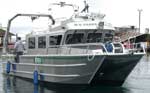 Parke Snavely |
Allen, R.M., Lacy, J.R., McGill, S.C., and Ferreira, J.C.T., 2021, Hydrodynamic, sediment transport, and sediment flocculation data from south San Francisco Bay, California, summer 2020: U.S. Geological Survey data release, https://doi.org/10.5066/P99Q4CHM.
Allen, R.M., Livsey, D.N., and McGill, S.C., 2024, Observations of flocs in an estuary and implications for computation of settling velocity: Journal of Geophysical Research - Oceans, 129, e2022JC019402, https://doi.org/10.1029/2022JC019402.
| Survey Equipment | Survey Info | Data Type(s) | Data Collected |
|---|---|---|---|
| watersamples | --- | Conductivity CTD Dissolved Oxygen Fluorescence Nitrate pH Temperature Turbidity Wave | Total suspended solids and particle size distributions from grab samples collected during four 0.25-day profiling periods in south San Francisco Bay, California, summer 2020 (Water samples were collected in south San Francisco Bay on four days in July 2020. The water samples were collected near pre-established USGS instrument moorings with a Niskin bottle, lowered from the R/V Snavely. Data are provided in comma-delimited values spreadsheets.) Profiles of salinity, temperature, depth, turbidity, and distributions of particle size in suspension collected during four 0.25-day periods in south San Francisco Bay, California, summer 2020 (Profiles of salinity, temperature, turbidity, and particle size distribution were collected by the U.S. Geological Survey (USGS) Pacific Coastal and Marine Science Center at two locations in south San Francisco Bay. Data were collected at depth intervals ranging between 0.5 and 2 m (depending on total water depth), sensors remained at each depth for 1 minute. Each profile was collected from surface to bed, and the near-surface region was sampled again at the end of the profile to check steady-state conditions. Profiles were collected for 4 days, for about 7.75 hours each day: Jul 21, 22, 24, and 28, 2020. Data files are grouped by site (channel or shallows) and by instrument (CTD or LISST). Users are advised to assess data quality carefully, and to check metadata for instrument information.) |
| grab sampler | --- | Surveys (geochemical) Geology | Grain size of bed sediment surface samples from south San Francisco Bay, California, summer 2020 (Bed sediment samples were collected in south San Francisco Bay on two days in July 2020 to analyze for sediment grain size distributions. Sediment samples were collected from the R/V Snavely near pre-established U.S. Geological Survey instrument moorings using a Gomex or Ponar box corer that was subsampled by scraping the top 0.5 cm of the core. Data are provided in a comma-delimited values spreadsheet.) |
| GPS | --- | Navigation | |
| instrumentmooring | --- | Geology Mooring (physical oceanography) | Hydrodynamic timeseries data from south San Francisco Bay, California, summer 2020 (Hydrodynamic and sediment transport time-series data, including water depth, velocity, turbidity, suspended particle size, conductivity, and temperature, were collected by the U.S. Geological Survey (USGS) Pacific Coastal and Marine Science Center at two locations in south San Francisco Bay. Data were collected in the channel (one platform) and in the shallows (three co-located platforms) for 2 weeks in July 2020. Data files are grouped by site (channel or shallows). Each site contained instrumentation to collect the data listed, with slight instrument and setup variations between the two sites due to logistics. Users are advised to assess data quality carefully, and to check metadata for instrument information, as platform deployment times and data-processing methods varied.) |