AKA: none
Other ID: Strategic Placement; DMP23
Status: Pending
Organization(s): USGS, Pacific Coastal and Marine Science Center
Funding Program(s): Sediment Transport in Coastal Environments (ZP00FDB)
Principal Investigator(s): Andrew Stevens, Jessica Lacy
Affiliate Investigator(s):
Information Specialist(s): Andrew Stevens
Data Type(s): Imagery: Photo, Sonar: Single Beam, Environmental Data: Turbidity, Sonar: Interferometric, Sampling: Geology, Time Series: Mooring (physical oceanography)
Scientific Purpose/Goals: Monitor dispersal of disposed dredged material.
Vehicle(s):
Start Port/Location: REDWOOD CITY, CA
End Port/Location: REDWOOD CITY, CA
Start Date: 2023-08-10
End Date: 2025-02-10
Equipment Used: Sediment Profile Imaging (SPI), Biosonics 200 kHz, watersamples, LISST, SWATH plus-M , Gomex Core, Push corer, Moorings - Tripods, RBR Virtuoso, RBR Duo, Nortek Vector ADV, CTD - RBR, ADCP - RDInstruments - 1200 kHz
Information to be Derived: Currents, waves, SSC, sediment properties, bathymetry.
Summary of Activity and Data Gathered: Repeat bathymetric mapping, deployment of oceanographic instruments, sediment sampling.
Staff: Peter Dartnell, Rachel Allen, Joanne Thede, Cordell Johnson, Daniel Powers, Peter Dal Ferro, Rachel Marcuson, Samantha McGill
Affiliate Staff:
Notes:
Location:
South San Francisco Bay
| Boundaries | |||
|---|---|---|---|
| North: 37.6136875 | South: 37.56090835 | West: -122.22770691 | East: -122.13535309 |
Platform(s):
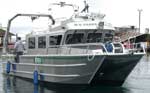 Parke Snavely | R/V Jewell |
McGill, S.C., Lacy, J.R., Stevens, A.W., Allen, R.M., Dartnell, P., Thede, J.C., Tan, A.C., Hatcher, G.A., 2025, Hydrodynamic, bathymetric, and sediment transport data spanning dredge material placement in south San Francisco Bay, California, 2023-2025: U.S. Geological Survey data release, https://doi.org/10.5066/P14D723N.
| Survey Equipment | Survey Info | Data Type(s) | Data Collected |
|---|---|---|---|
| Sediment Profile Imaging (SPI) | --- | Photo | In situ sediment profile images from south San Francisco Bay, California, 2023-2025 (In situ images of the sediment-water interface and sediment profiles were collected to characterize the top layer of the sediment bed (less than 15 cm sediment depth) prior to dredged material placement and post dredge material placement in south San Francisco Bay, California. Several sites within the placement area, as well as sites outside of the placement area, and near time-series stations were collected. The photos were acquired during four separate trips: August 2023 (pre-placement), October 2023 (pre-placement), January 2023 (post-placement), and February (greater than 1 year post-placement). The sediment profile imaging system consisted of a Blackfly S Board-level BFS-GE-50S5C0BD2 camera that incorporates a Sony IMX264 sensor and has an m12-mount type wide-angle 4.4 mm lens. The resulting field of view was approximately 7x15 cm at the window, with a resolution of 0.0667 mm per pixel when the vertically (portrait) oriented window of the housing was pushed into the sediment bed. The camera was secured horizontally in Sediment Profile Imaging (SPI) camera waterproof housing from OceanInstruments, which was lowered to the bay floor at the different stations and pushed from above into the sediment bed using a rigidly attached pole. The images captured using the system show a profile view which includes a surface view of the sediment bed where the window was above the water-sediment interface, and/or a high-resolution sediment profile where the window extended vertically down into the sediment bed and was flush with the sediment. The maximum depth below the water-sediment interface recorded by the sediment profile imaging camera was approximately 15 cm.) |
| Biosonics 200 kHz | --- | Single Beam | |
| watersamples | --- | Conductivity CTD Dissolved Oxygen Fluorescence Nitrate pH Temperature Turbidity Wave | Suspended sediment concentrations from water samples collected in south San Francisco Bay, California, 2023-2024 (Water samples were collected in south San Francisco Bay between August 2023 and August 2024 to measure suspended sediment concentration. The water samples were collected near USGS instrument platforms (see time-series data page) with a peristaltic pump. The suspended sediment concentrations of the samples were determined at the USGS Pacific Coastal and Marine Science Center sediment lab. Measured suspended sediment concentrations were used to calculate calibration coefficients that can be used to convert time series of turbidity data to time series of suspended sediment concentrations. These calibration coefficients can be found in file: DMP23_Turbidity_to_SSC_calibration_constants.csv, one of the support files for the time-series data section of this data release.) |
| LISST | --- | Mooring (physical oceanography) | |
| SWATH plus-M | --- | Interferometric | Acoustic-backscatter data from repeat side-scan sonar surveys of south San Francisco Bay, California, 2023-2025 (Acoustic-backscatter data were collected with a 234 kHz SwathPlus interferometric side-scan sonar during repeat bathymetric surveys of south San Francisco Bay, California between 2023 and 2025. Data were collected and processed by the U.S. Geological Survey (USGS), Pacific Coastal and Marine Science Center (PCMSC) with fieldwork activity number 2023-655-FA. Data are provided as a GeoTIFF images.) |
| Gomex Core | --- | Geology | |
| Push corer | --- | Chemistry Surveys (geochemical) Surveys (biological) Biology Geology | |
| Moorings - Tripods | --- | Mooring (physical oceanography) | |
| RBR Virtuoso | --- | Mooring (physical oceanography) Tide Wave Turbidity pH ORP Fluorescence Dissolved Oxygen Temperature Pressure CTD | |
| RBR Duo | --- | Mooring (physical oceanography) | |
| Nortek Vector ADV | --- | Temperature Mooring (physical oceanography) Wave Tide Pressure Current | |
| CTD - RBR | --- | CTD Mooring (physical oceanography) | |
| ADCP - RDInstruments - 1200 kHz | --- | Current Wave Mooring (physical oceanography) |