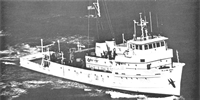
The general scientific objective of the cruise was to obtain quasi-synoptic information on the suspended sediment transport system within the South Texas OCS. Specific objectives consisted of the following: A) obtaining samples of the water column for textural patterns, B) obtaining vertical transmittance-temperature profiles in order to establish seasonal turbidity patterns, and C) casting drift bottles to measure surface currents during the cruise period.
Location
South Texas outer continental shelf, Matagorda Bay, Texas, United States, Gulf of America (Gulf of Mexico), North America, North Atlantic;
Summary
Vertical transmittance-temperature profiles of the water column at 24 stations; 3 water column samples (surface, mid-depth, bottom) at each station; Drift bottles cast: 190; Ship track: 900 km; Number of sample types: 78 water samples, 26 vertical transmittance-temperature profiles.
Info derived
Time series data; Samples and chemical analysis;
Comments
Coastal inlet stations (#1, 1A, 2, 9, 9A, 23, 23A): radar navigation. Deeper water stations: LORAN-A. This cruise was the second of three cruises designed to evaluate the seasonal variability of suspended sediment transport patterns within the South Texas OCS region. The remaining third cruise is scheduled for May 1976. Original Center People field contained: Gerald Shideler, Stan Lindquist, David Solar, Fran Firek, Jimmy Barta, Bob Vitaglione, Scott Heald, Betty Willingham, Cindy Rice, and Dee Haines.
Project = South Texas OCS, South Texas OCS
Manual for successive Fay cruises conducted between March and June 1976 in the Gulf of Mexico including daily log of ship movement, equipment and data acquisition notes, personnel, track maps. Very extensive report including figures of data with explanations. Includes information for the following field activities: 1976-004-FA, 1976-005-FA, 1976-007-FA, 1976-011-FA, 1976-013-FA, 1976-015-FA.