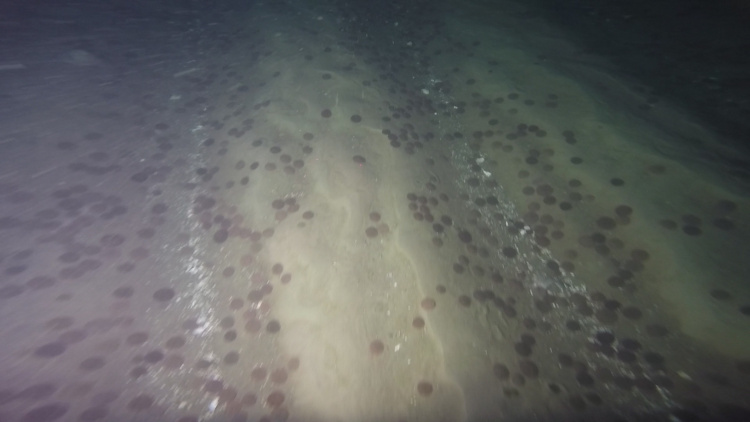
A Python script (writeexif_2_readfile_03_01_21_IDS.py executed with IDLE version 2.7.14 on a Windows 2010 machine) was run that incorporated the information from 2016-004-FA_image_locations.csv, along with additional information, into the appropriate tags in the EXIF header of each GoPro grab image. Although the two images from each station are not from the exact same place, the same information for that station was populated in each photo. The Python script uses ExifTool ( version 11.54
https://exiftool.org ) to write the information to the image headers of the full-resolution images. The following tags were populated in the JPEG image headers. Information is duplicated in some tags because different software packages access different tags.
GPS tags: The values populated are unique for each station and based on the information exported from 2016-004-FA_station_data_summary.csv with the exception of the datum and area information. The date and time stamps are based on UTC.
GPSLatitudeRef
GPSLatitude
GPSLongitudeRef
GPSLongitude
GPSTimeStamp
GSPDateStamp
GPSMapDatum : EPSG:4326 (WGS 84)
GPSAreaInformation: Position post-processed from GPS on ship

Another element that is unique for each image is the XMP tag for the original filename.
OriginalFileName
JPEG tag: The tag is listed along with the information used to populate it, which is the same for every image.
comment: Image grabs from a GoPro digital video camera mounted on the USGS SEABOSS deployed from the R/V Auk during survey 2016-004-FA ( https://cmgds.marine.usgs.gov/fan_info.php?fan=2016-004-FA ).
EXIF tags: The tag is listed along with the information used to populate it, which is the same for every image.
ImageDescription: Image grab of the sea floor on Stellwagen Bank, MA from survey 2016-004-FA
Artist: Page C. Valentine
Copyright: Public Domain - please credit U.S. Geological Survey
UserComment: Image part of USGS data release https://doi.org/10.5066/P934L7PN
Make: GoPro
IPTC tags: The tag is listed along with the information used to populate it, which is the same for every image.
Credit: U.S. Geological Survey
Contact: [email protected]
keywords: Stellwagen Bank, Massachusetts, 2016-004-FA, SEABOSS, sea floor, USGS, ground-truth, https://doi.org/10.5066/P934L7PN
CopyrightNotice: Public Domain - please credit U.S. Geological Survey
Caption-Abstract: Image grab of the sea floor on Stellwagen Bank, MA from survey 2016-004-FA
XMP tag: The tag is listed along with the information used to populate it - which is the same for every image except for the ImageUniqueID, which is unique for each image.
Caption: Image grab of the sea floor on Stellwagen Bank, MA from survey 2016-004-FA
AttributionURL: https://cmgds.marine.usgs.gov/fan_info.php?fan=2016-012-FA
Author: Page C. Valentine
Another script run in Python Notebooks (Image_PIDwork.ipnb) was used to mint a unique persistent identifier (image PID) for each image and placed in the header. Additionally, the persistent URL for the metadata record associated with this dataset was also inserted into the image header.
XMP tag:
ImageUniqueID: The persistent identifier (PID) value minted in the Persistent Identifier Registration (PIR) Tool
ExternalMetadataLink: https://www1.usgs.gov/pir/api/identifiers/XXXXX
UsageTerms: Unless otherwise stated, all data, metadata and related materials are considered to satisfy the quality standards relative to the purpose for which the data were collected. Although these data and associated metadata have been reviewed for accuracy and completeness and approved for release by the U.S. Geological Survey (USGS), no warranty expressed or implied is made regarding the display or utility of the data for other purposes, nor on all computer systems, nor shall the act of distribution constitute any such warranty.
From the command-line in Cygwin, the image name was also added to the header with the following command: exiftool -P "-originalfilename<Filename" *.jpg
To extract the information from the image headers using ExifTool, the following command can be used (tested with ExifTool version 11.54, slight modifications of the command might be necessary depending on the operating system of the user):
exiftool.exe -csv -f -filename -GPSTimeStamp -GPSDateStamp -GPSLongitude -GPSLatitude -n -GPSMapDatum -GPSAreaInformation -Artist -Credit -comment -contact -keywords -Caption -Copyright -CopyrightNotice -Caption-Abstract -ImageDescription -UserComment -AttributionURL -GPSAreaInformation -Author -Contributor -ImageUniqueID -ExternalMetadataLink -Make -UsageTerms -OriginalFileName *.jpg > out.csv
The -csv flag writes the information out in a comma-delimited format. The -n option formats the latitude and longitude as signed decimal degrees. Whether you use exiftool or exiftool.exe will depend on the system on which the command is being run.