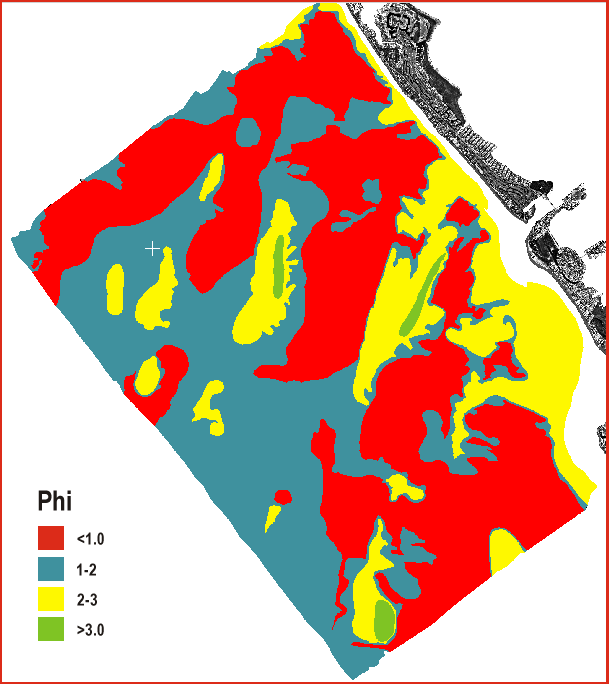
Phi class interpretation coverage from Sarasota Florida study area

Metadata also available as - [Outline] - [Parseable text] - [XML]

Frequently anticipated questions:


What does this data set describe?

Title:
Phi class interpretation coverage from Sarasota Florida study area
Abstract:
The U.S. Geological Survey, in cooperation with the University of South Florida and Eckerd College, completed a bathymetric, sidescan sonar, high-resolution seismic-reflection, and surface sediment sampling survey of the inner shelf environment along the western Florida coast. The survey area extends 15km from Sarasota Point to Buttonwood Harbor. This study is part of a larger program initiated by the U.S. Geological Survey to map the geologic framework and monitor the modern processes that affect the western Florida coastal zone. This portion of the project included a reconnaissance high-resolution seismic and side-scan sonar surveys of the entire study area, detailed mapping to identify patterns of hard grounds and sediment cover, and coring of sediments to document historical development of the inner shelf and coastal system.
Supplemental_Information:
These data were collected on U.S. Geological Survey field activity 1995-004-FA (BLWS 95-04) https://cmgds.marine.usgs.gov/services/activity.php?fan=1995-004-FA .
  1. How might this data set be cited?
    Twichell, Dave, 1999, Phi class interpretation coverage from Sarasota Florida study area: Open-File Report 99-396, U.S. Geological Survey, Coastal and Marine Geology Team, Woods Hole Field Center.

    Online Links:

    This is part of the following larger work.

    Twichell, David C., and Paskevich, Valerie F., 1999, Bathymetry, sidescan sonar image, surface sediments, and surfical geological map of the inner shelf off Sarasota, Florida: Preliminary discussion and GIS database release: Open-File Report 99-396, U.S. Geological Survey, Reston, VA.

    Online Links:

    Other_Citation_Details:
    Suggested citation: Twichell, D.C., and Paskevich, V.F., 1999, Bathymetry, sidescan sonar image, surface sediments, and surfical geological map of the inner shelf off Sarasota, Florida— Preliminary discussion and GIS database release: U.S. Geological Survey Open-File Report 99-396, https://doi.org/10.3133/ofr99396
  2. What geographic area does the data set cover?
    West_Bounding_Coordinate: -82.7329
    East_Bounding_Coordinate: -82.5676
    North_Bounding_Coordinate: 27.3856
    South_Bounding_Coordinate: 27.2164
  3. What does it look like?
    https://pubs.usgs.gov/of/1999/of99-396/htmldocs/images/covrgs/phi.gif (phi class coverage overlaid on sidescan sonar mosaic)
    GIF
  4. Does the data set describe conditions during a particular time period?
    Beginning_Date: 02-May-1994
    Ending_Date: 08-May-1994
    Currentness_Reference:
    Ground Condition
  5. What is the general form of this data set?
    Geospatial_Data_Presentation_Form: vector digital data
  6. How does the data set represent geographic features?
    1. How are geographic features stored in the data set?
      This is a Vector data set. It contains the following vector data types (SDTS terminology):
      • GT-polygon composed of chains (30)
    2. What coordinate system is used to represent geographic features?
      Horizontal positions are specified in geographic coordinates, that is, latitude and longitude. Latitudes are given to the nearest .00002. Longitudes are given to the nearest .00002. Latitude and longitude values are specified in Decimal degrees. The horizontal datum used is North American Datum of 1983.
      The ellipsoid used is GRS80.
      The semi-major axis of the ellipsoid used is 6378137.0.
      The flattening of the ellipsoid used is 1/298.257222101.
  7. How does the data set describe geographic features?
    phi.dbf
    Shapefile Attribute Table (Source: None)
    Area
    AREA of polygon. The Area attribute is carried over from the AREA attribute in ARC/INFO. Area is an ARC/INFO internal control parameter and has no relevance to the use of the data. (Source: Software computed)
    Range of values
    Minimum:0.00
    Maximum:0.005
    Perimeter
    PERIMTER of polygon. The Perimter attribute is carried over from the PERIMTER attribute in ARC/INFO. Perimeter is an ARC/INFO internal control parameter and has no relevance to the use of the data. (Source: Software computed)
    Range of values
    Minimum:0.014
    Maximum:2.472
    Phi_
    Phi_ is carried over from the ARC/INFO attribute PHI#. PHI# is an ARC/INFO internal control parameter and has no applicable relevance to the use of the data. (Source: User Defined)
    Range of values
    Minimum:2
    Maximum:31
    Phi_id
    Phi_id is carried over from the ARC/INFO attribute PHI_ID. PHI_ID is an ARC/INFO internal control parameter and has no applicable relevance to the use of the data. (Source: User Defined)
    Range of values
    Minimum:1
    Maximum:30
    Code
    A numeric code assigned to the polygon that may be used for color assignments. The codes relate to a general phi class break assigned to the polygons by the researcher drawing the interpretation. Boundaries were drawn based on the value contained in the analyzed surface sample and their distribution over the study area. The codes and the description are listed below. 1 - < 1.0 phi - very coarse sand and gravel 2 - 1-2 phi - medium sand 3 - 2-3 phi - fine sand 4 - >3.0 phi - very fine sand (Source: User Defined)
    Range of values
    Minimum:1
    Maximum:4
    Class
    Class is a text field that is assigned as a description of the phi range of the code assigned to the polygon that may be used as a legend text label. The Class field relates to the code assigned to the polygons by the researcher drawing the interpretation. Boundaries were drawn based on the value contained in the analyzed surface sample and their distribution over the study area. The codes and the description are listed below. 1 - < 1.0 phi - very coarse sand and gravel 2 - 1-2 phi - medium sand 3 - 2-3 phi - fine sand 4 - >3.0 phi - very fine sand (Source: User Defined) Character field
    Descriptio
    Descriptio is a text field that is assigned as a description of the phi range of the code assigned to the polygon that may be used as a legend text label. The Descriptio field relates to the code assigned to the polygons by the researcher drawing the interpretation. Boundaries were drawn based on the value contained in the analyzed surface sample and their distribution over the study area. The codes and the description are listed below. 1 - very coarse sand and gravel 2 - medium sand 3 - fine sand 4 - very fine sand (Source: User Defined) Character field

Who produced the data set?

  1. Who are the originators of the data set? (may include formal authors, digital compilers, and editors)
    • Dave Twichell
  2. Who also contributed to the data set?
  3. To whom should users address questions about the data?
    U. S. Geological Survey
    Attn: Dave Twichell
    Oceanographer
    384 Woods Hole Road
    Woods Hole, MA
    USA

    (508) 548-8700 x2266 (voice)
    (508) 457-2310 (FAX)
    dtwichell@usgs.gov

Why was the data set created?

This GIS overlay is a component of the Sarasota, Florida ArcView GIS database and contains the researcher's interpretation of the area utilizing phi class breaks from the grain size analysis of collected samples from the study area.

How was the data set created?

  1. From what previous works were the data drawn?
  2. How were the data generated, processed, and modified?
    Date: Unknown (process 1 of 2)
    The interpretation was drawn over the sidescan sonar mosaic utilizing the PCI remote sensing software Imageworks. The completed mosaic was georeferenced to the UTM zone 17. Using information from the grain size analysis of collected samples, the interpretation was interactively drawn over the image as a bitmap graphic and saved in the PCI image database file. The saved graphic was exported from PCI as an ArcView shapefile and imported to the Sarasota ArcView GIS database. Person who carried out this activity:
    Dave Twichell
    U.S. Geological Survey
    Oceanographer
    384 Woods Hole Road
    Woods Hole, MA
    USA

    (508) 548-8700 x2266 (voice)
    (508) 457-2310 (FAX)
    dtwichell@usgs.gov
    Data sources produced in this process:
    • phi class interpretation of Sarasota, FL sidescan sonar mosaic using grain size analysis information from samples
    Date: 12-Aug-2025 (process 2 of 2)
    This metadata file was edited for inclusion in the CMHRP metadata inventory. These edits included but are not limited to converting the metadata from HTML to XML format; fixing the publication date; added additional information in the identification section such as adding the series information, larger work ctation as well as the online links. Added the field activity number and link to the supplemental information; added the ISO 19115 Topic Category and USGS Thesaurus and appropriate terms; added the full URL to the browse graphic; specified that the information was not available freom the original metadata in some of the fields; updated the distribution liability with an FSP approved statement; added the online digital transfer option and links; updated the metadata date; provided a generic email and contact instructions in the metadata contact section; fixed all errors. The original metadata specified the North American Datum of 1983 for the horizontal datum, with the ellipsoid being WGS84. This is not possible. So the ellipsoid was modified to the GRS80 ellipsoid and associated values which is in alignment with a NAD83 datum. A persistent identifier (PID) was added to the metadata in the thesaurus section. (20250812) Person who carried out this activity:
    U.S. Geological Survey
    Attn: VeeAnn A. Cross
    Marine Geologist
    384 Woods Hole Rd.
    Woods Hole, MA
    USA

    (508) 548-8700 x2251 (voice)
    (508) 457-2310 (FAX)
    vatnipp@usgs.gov
  3. What similar or related data should the user be aware of?

How reliable are the data; what problems remain in the data set?

  1. How well have the observations been checked?
  2. How accurate are the geographic locations?
    No information was available in the original metadata.
  3. How accurate are the heights or depths?
  4. Where are the gaps in the data? What is missing?
    No information available from the original metadata.
  5. How consistent are the relationships among the observations, including topology?
    No information available from the original metadata.

How can someone get a copy of the data set?

Are there legal restrictions on access or use of the data?
Access_Constraints None
Use_Constraints The U.S. Geological Survey must be referenced as the originator of the dataset in any future products or research derived from these data.
  1. Who distributes the data set? (Distributor 1 of 1)
    U. S. Geological Survey
    Attn: Dave Twichell
    Oceanographer
    384 Woods Hole Road
    Woods Hole, MA
    USA

    (508) 548-8700 x2266 (voice)
    (508) 457-2310 (FAX)
    dtwichell@usgs.gov
  2. What's the catalog number I need to order this data set? phi class interpretation coverage for Sarasota, FL study area
  3. What legal disclaimers am I supposed to read?
    Unless otherwise stated, all data, metadata and related materials are considered to satisfy the quality standards relative to the purpose for which the data were collected. Although these data and associated metadata have been reviewed for accuracy and completeness and approved for release by the U.S. Geological Survey (USGS), no warranty expressed or implied is made regarding the display or utility of the data for other purposes, nor on all computer systems, nor shall the act of distribution constitute any such warranty.
  4. How can I download or order the data?
  5. What hardware or software do I need in order to use the data set?
    Phi class breaks interpretive coverage of analyzed surface sediments for the study area is available in ArcView shapefile format. The user must have ArcView to read and process the data file or another GIS application package capable of importing the data.

Who wrote the metadata?

Dates:
Last modified: 12-Aug-2025
Metadata author:
U. S. Geological Survey
Attn: Valerie Paskevich
Computer Specialist
384 Woods Hole Rd.
Woods Hole, MA
USA

(508) 548-8700 x2281 (voice)
(508) 457-2310 (FAX)
whsc_data_contact@usgs.gov
Contact_Instructions:
The metadata contact email address is a generic address in the event the metadata contact is no longer with the U.S. Geological Survey.
Metadata standard:
FGDC Content Standards for Digital Geospatial Metadata (FGDC-STD-001-1998)

This page is <https://cmgds.marine.usgs.gov/catalog/whcmsc/open_file_report/ofr1999-396/phi_meta.faq.html>
Generated by mp version 2.9.51 on Tue Aug 12 17:03:17 2025