Time-series measurements of oceanographic data collected in the nearshore zone offshore of Marconi Beach, Wellfleet, MA, December 9, 2024 to March 10, 2025

Metadata also available as - [Outline] - [Parseable text] - [XML]

Frequently anticipated questions:


What does this data set describe?

Title:
Time-series measurements of oceanographic data collected in the nearshore zone offshore of Marconi Beach, Wellfleet, MA, December 9, 2024 to March 10, 2025
Abstract:
The U.S. Geological Survey (USGS) Woods Hole Coastal and Marine Science Center deployed a four-legged bottom landing frame (nanopod) containing oceanographic instruments to collect measurements of winter wave conditions directly offshore of Marconi Beach in Wellfleet, MA. Supplementary sediment samples were collected to characterize grain size. Marconi Beach is the site of ongoing measurements of wave runup, and this field work provides information on the incident waves and water levels that are ultimately responsible for wave runup on the beach. Maps of subaerial topography and nearshore bathymetry were made to augment the wave and runup measurements. These observations will allow us to test and validate models of wave shoaling and transformation and generation of wave runup. The larger objective of this work is to provide validation and indicate needed improvements for the Total Water Level and Coastal Change forecasts made publicly available in real time by the USGS. These forecasts provide information that emergency managers and the American public can use to help safeguard coastal property, businesses, energy production and distribution facilities, and national security installations.
Supplemental_Information:
This work was supported by the U.S. Geological Survey Coastal and Marine Hazards and Resources Program as part of the Next Generation Total Water Level and Coastal Change Forecast project. More information about the field activities during which these data were collected is available at https://cmgds.marine.usgs.gov/fan_info.php?fan=2024-028-FA and https://cmgds.marine.usgs.gov/fan_info.php?fan=2025-010-FA. Once published these data will be accessible through the Ocean Time-Series Data portal at https://cmgds.marine.usgs.gov/ocean-time-series/ by experiment (caco-waves) or THREDDS catalog (10.5066-P13KF7UW), along with other similar time-series data sets published by Coastal and Marine Hazards and Resources Program.
  1. How might this data set be cited?
    De, Olivia A. Meo, Suttles, Steven E., Marsjanik, Eric D., Bales, Robert D., and Sherwood, Christopher R., 20260108, Time-series measurements of oceanographic data collected in the nearshore zone offshore of Marconi Beach, Wellfleet, MA, December 9, 2024 to March 10, 2025: data release DOI:10.5066/P13KF7UW, U.S. Geological Survey, Woods Hole Coastal and Marine Science Center, Woods Hole, Massachusetts.

    Online Links:

    Other_Citation_Details:
    Suggested citation: De Meo, O.A., Suttles, S.E., Marsjanik, E.D., Bales, R.D., and Sherwood, C.R., 2026, Time-series measurements of oceanographic data collected in the nearshore zone offshore of Marconi Beach, Wellfleet, MA, December 9, 2024 to March 10, 2025: U.S. Geological Survey data release, https://doi.org/10.5066/P13KF7UW.
  2. What geographic area does the data set cover?
    West_Bounding_Coordinate: -69.94247
    East_Bounding_Coordinate: -69.94247
    North_Bounding_Coordinate: 41.89786
    South_Bounding_Coordinate: 41.89786
  3. What does it look like?
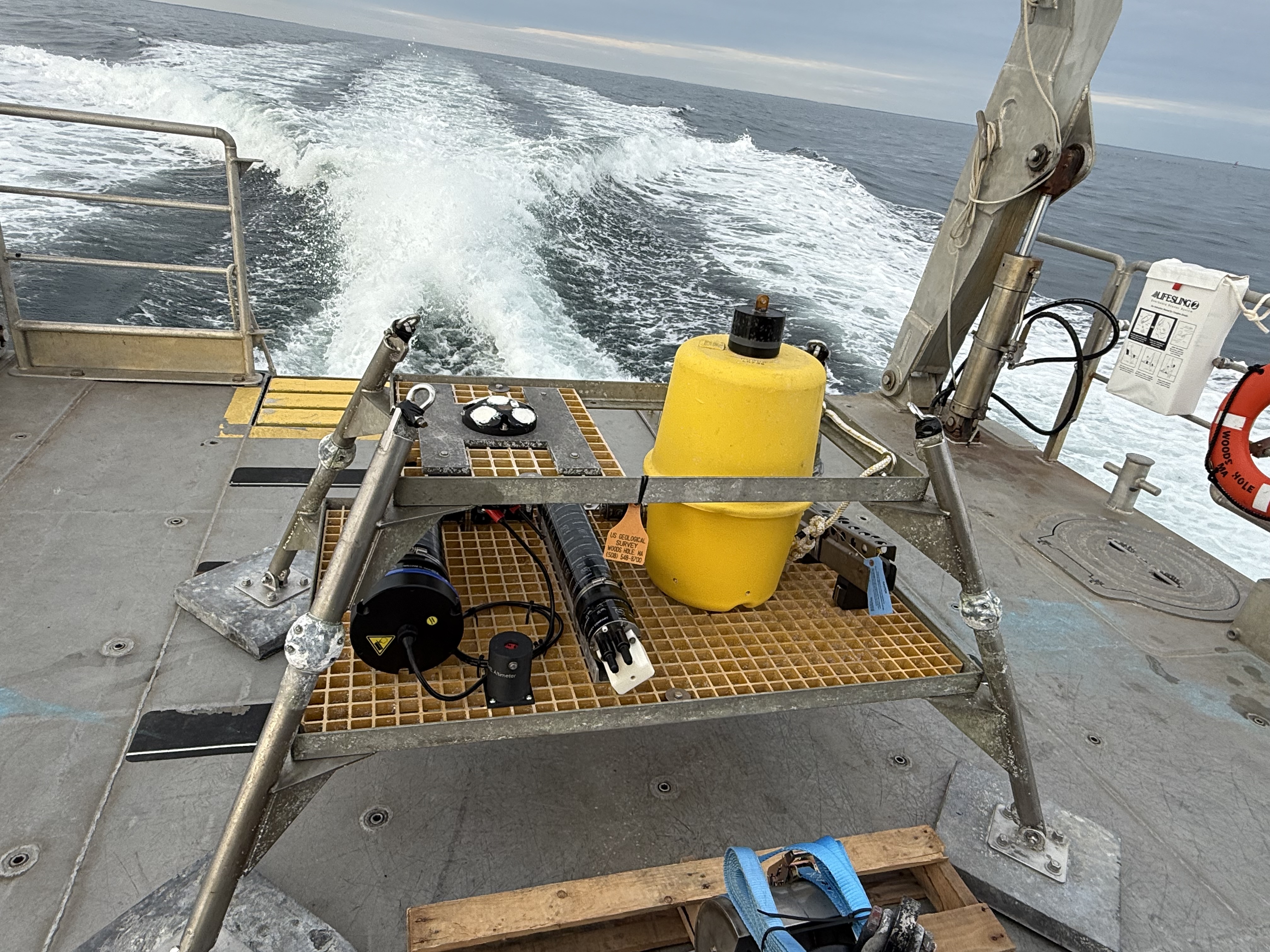
    https://cmgds.marine.usgs.gov/data-releases/media/2025/10.5066-P13KF7UW/a1b5fa06689d4c2d8775f18b8081cfd9/nanopod.JPG (JPEG)
    Photo of nanopod with attached sensors.
  4. Does the data set describe conditions during a particular time period?
    Beginning_Date: 09-Dec-2024
    Ending_Date: 10-Mar-2025
    Currentness_Reference:
    ground condition at time data were collected
  5. What is the general form of this data set?
    Geospatial_Data_Presentation_Form: netCDF
  6. How does the data set represent geographic features?
    1. How are geographic features stored in the data set?
      This is a Point data set.
    2. What coordinate system is used to represent geographic features?
      Horizontal positions are specified in geographic coordinates, that is, latitude and longitude. Latitudes are given to the nearest 0.00001. Longitudes are given to the nearest 0.00001. Latitude and longitude values are specified in Decimal degrees. The horizontal datum used is North American Datum of 1983 (National Spatial Reference System 2011).
      The ellipsoid used is GRS_1980.
      The semi-major axis of the ellipsoid used is 6378137.000000.
      The flattening of the ellipsoid used is 1/298.257222.
      Vertical_Coordinate_System_Definition:
      Altitude_System_Definition:
      Altitude_Datum_Name: North American Vertical Datum of 1988 using Geoid 18
      Altitude_Resolution: 0.01
      Altitude_Distance_Units: meters
      Altitude_Encoding_Method:
      Explicit elevation coordinate included with horizontal coordinates
      Depth_System_Definition:
      Depth_Datum_Name: Mean sea level
      Depth_Resolution: 0.01
      Depth_Distance_Units: meters
      Depth_Encoding_Method: Explicit depth coordinate included with horizontal coordinates
  7. How does the data set describe geographic features?
    11751sigb.nc
    Continuously-sampled (4 Hz) data of profiled horizontal and vertical water velocities from the 4 slant beams, acoustic surface tracking, pressure, heading, and tilt data of "Burst" data type (b) from upward looking Nortek Signature 1000 5-beam ADCP. Contains 31,442,880 time points with time interval of 0.25 seconds. (Source: Coastal and Marine Hazards and Resources Program (CMHRP))
    11751sigb-a.nc
    Time-averaged data of profiled horizontal and vertical water velocities from 4 slant beams, acoustic surface tracking, pressure, heading, and tilt data of "Burst" data type (b) from upward looking Nortek Signature 1000 5-beam ADCP. Contains 21,835 time points with time interval = 360 seconds. (Source: Coastal and Marine Hazards and Resources Program (CMHRP))
    11751sigs-a.nc
    Non-directional wave statistics calculated using the rapidly sampled data of "Burst" data type from upward looking Nortek Signature 1000 5-beam ADCP. Contains 2,182 time points with time interval of 3,600 seconds. (Source: Coastal and Marine Hazards and Resources Program (CMHRP))
    11751sigs_diwasp-a.nc
    Directional wave statistics calculated using rapidly sampled data of "Burst" data type from upward looking Nortek Signature 1000 5-beam ADCP using the pyDIWASP directional wave processing libraries (diwasp). Contains 2,182 time points with time interval of 3,600 seconds. (Source: Coastal and Marine Hazards and Resources Program (CMHRP))
    11751sigb5.nc
    Continuously-sampled (4 Hz) data of profiled vertical water velocities from beam 5 (center), pressure, heading, and tilt data of "IBurst" data type (b5) from upward looking Nortek Signature 1000 5-beam ADCP. Contains 31,442,880 time points with time interval of 0.25 seconds. (Source: Coastal and Marine Hazards and Resources Program (CMHRP))
    11751sigb5-a.nc
    Time-average data of profiled vertical water velocities from beam 5 (center), pressure, heading, and tilt data of "IBurst" data type (b5) from upward looking Nortek Signature 1000 5-beam ADCP. Contains 21,835 time points with time interval of 360 seconds. (Source: Coastal and Marine Hazards and Resources Program (CMHRP))
    11752sgt-a.nc
    Pressure and water level data from Seabird SBE26 Seagauge Wave and Tide recorder. Contains 21,835 time points with time interval of 360 seconds. (Source: Coastal and Marine Hazards and Resources Program (CMHRP))
    11753mc-a.nc
    Water temperature, conductivity, and salinity data from Seabird SBE37 MicroCat. Contains 21,615 time points with time interval of 360 seconds. (Source: Coastal and Marine Hazards and Resources Program (CMHRP))
    11754aab.nc
    Burst-sampled height above seabed from EofE Echologger AA400 Altimeter. Contains 21,655 time points with time interval of 360 seconds, and 10 samples at each time point with sample interval of 1 second. (Source: Coastal and Marine Hazards and Resources Program (CMHRP))
    11754aab-a.nc
    Burst-averaged height above seabed from EofE Echologger AA400 Altimeter. time = 21,655 points, time interval = 360 seconds. (Source: Coastal and Marine Hazards and Resources Program (CMHRP))
    Entity_and_Attribute_Overview:
    NetCDF files are self-describing and attribute information may be found in the header of the file itself. This information can be viewed for each file, without downloading the file, by using THREDDS catalog in the Ocean Time-Series Data portal and OpenDAP access upon selecting a file. See access instruction element in this metadata record for more information.
    Entity_and_Attribute_Detail_Citation:
    The entity and attribute information were generated by the data release first author, unless otherwise noted. Please review the rest of the metadata record for additional details and information.

Who produced the data set?

  1. Who are the originators of the data set? (may include formal authors, digital compilers, and editors)
    • Olivia A. De Meo
    • Steven E. Suttles
    • Eric D. Marsjanik
    • Robert D. Bales
    • Christopher R. Sherwood
  2. Who also contributed to the data set?
  3. To whom should users address questions about the data?
    Olivia A. De Meo
    U.S. Geological Survey, Northeast Region
    Physical Scientist
    384 Woods Hole Road
    Woods Hole, MA
    US

    508-548-8700 x2356 (voice)
    whsc_data_contact@usgs.gov
    Contact_Instructions:
    The contact email address is a generic address in the event the person is no longer with USGS.

Why was the data set created?

A submerged nanopod was deployed to collect time series data of temperature, conductivity, salinity, seabed height, pressure, water velocity and acoustic surface tracking.

How was the data set created?

  1. From what previous works were the data drawn?
  2. How were the data generated, processed, and modified?
    Date: 09-Dec-2024 (process 1 of 4)
    A nanopod mounted with a Nortek Signature, a Seabird Microcat, a Seabird Seagauge, an EofE EchoLogger, and Edgetech releases was loaded onto the R/V Tioga in Woods Hole, MA. The ship sailed to Marconi Beach, MA. The nanopod was lowered into the water and the latitude and longitude were recorded. The releases were pinged and a signal was received back indicating the nanopod was upright. Olivia De Meo is the contact for this process step and all subsequent process steps. Person who carried out this activity:
    Olivia A. De Meo
    U.S. Geological Survey, Northeast Region
    Physical Scientist
    384 Woods Hole Road
    Woods Hole, MA
    US

    508-548-8700 x2356 (voice)
    whsc_data_contact@usgs.gov
    Contact_Instructions:
    The contact email address is a generic address in the event the person is no longer with USGS.
    Date: 10-Mar-2025 (process 2 of 4)
    The R/V Tioga sailed from Woods Hole, MA to Marconi Beach, MA. The releases were pinged and a signal was received back indicating the nanopod was upright. The release command was initiated and the nanopod was hooked and raised onto the deck. All instruments were clean and free of biofouling. All data were downloaded from the instruments using the manufacturer's software.
    Date: Apr-2025 (process 3 of 4)
    The raw data files from each sensor were processed and converted to netCDF using the stglib Python library, a package of code to process data consistent with procedures of the USGS Coastal/Marine Hazards and Resources Program; see "history" global attribute in each processed netCDF file for stglib and python versions used. In stglib, attributes conforming to Climate and Forecast (CF) Conventions were added; see "Conventions" global attribute in processed netCDF files for CF version used. All times are in Coordinated Universal Time (UTC). For all pressure sensors, corrected pressure data (P_1ac) were calculated by finding an offset with local atmospheric pressure readings when the pressure sensor was reading in air just prior to deployment. Pressure data were corrected using the offset and a time-series of local atmospheric pressure over the course of the deployment to remove the atmospheric contribution to the deployed pressure data. The resulting corrected pressure variable is the pressure due to seawater (standard_name "sea_water_pressure_due_to_seawater" in netCDF files). Data quality assurance and quality control (QAQC) was performed by inspecting all variables and replacing spurious values with the fill value. Details of which portions of data were flagged and replaced are available in the metadata in each netCDF file and information about the individual QAQC trimming functions are available in the stglib documentation (https://stglib.readthedocs.io/en/latest/) in the "Instrument configuration file" section. The root of the netCDF files are named using the convention ####XZZZ where '####' is the mooring number, 'X' is the position on the mooring of the sensor with 1 being closest to the surface, and 'ZZZ' (length between 2 and 5 characters) is an abbreviation for the instrument that was deployed; see instrument abbreviations table in stglib documentation https://cmgp.code-pages.usgs.gov/stglib/insttbl.html. After instrument abbreviation there are additional processed file suffixes that identify the type and level of processing; '-a' is Best Basic Version (BBV = highest level of processing), 'b' is burst or continuous fast sample rate data, 's' is wave statistics from built-in stglib, 's_diwasp' is wave statistics from pyDIWASP library, and 't' is tide data. For example, in the file 11753mc-a.nc, '1175' is the mooring number, '3' is the position of the sensor on the mooring, and 'mc' refers to the Seabird MicroCAT sensor, and '-a' indicates it is BBV.
    Date: 09-Jan-2026 (process 4 of 4)
    Metadata was modified to fix a typo in the browse graphic link. (20260109) Person who carried out this activity:
    U.S. Geological Survey
    Attn: VeeAnn A. Cross
    Marine Geologist
    384 Woods Hole Rd.
    Woods Hole, MA
    USA

    (508) 548-8700 x2251 (voice)
    (508) 457-2310 (FAX)
    vatnipp@usgs.gov
  3. What similar or related data should the user be aware of?
    De, Olivia A. Meo, Suttles, Steven E., Marsjanik, Eric D., Bales, Robert D., and Sherwood, Chris R., 2025, Grain-size analysis of sediment samples collected in the nearshore zone offshore of Marconi Beach, Wellfleet, MA, December 9, 2024: data release DOI:10.5066/P14KORS8, U.S. Geological Survey, Woods Hole Coastal and Marine Science Center, Woods Hole, Massachusetts.

    Online Links:

    Nowacki, Daniel J., Suttles, Steven E., Bales, Robert D., and De, Olivia A. Meo, 2024, stglib: Oceanographic Time Series Data Processing Library: U.S. Geological Survey software release DOI:10.5066/P13IQYFW, U.S. Geological Survey, Reston, VA.

    Online Links:


How reliable are the data; what problems remain in the data set?

  1. How well have the observations been checked?
    The Sea-Bird SBE37 MicroCAT has a conductivity accuracy of +/- 0.0003 S/m, temperature accuracy of +/-0.002 degrees Celsius, and pressure accuracy of +/- 0.1% full scale. The Sea-Bird SBE26plus Seagauge has a temperature accuracy of +/- 0.01 degrees Celsius and pressure accuracy of +/- 0.01% full scale. The Nortek Signature 1000 has a velocity accuracy of 0.3% of measured value +/- 0.3 cm/s, temperature accuracy of +/- 0.1 degrees Celsius, pressure accuracy of +/- 0.1% full scale, and compass accuracy of +/- 2 degrees. The EofE EchoLogger has a temperature accuracy of +/- 0.5 degrees Celsius, tilt accuracy of +/- 0.1 degrees, and range resolution up to 1 mm.
  2. How accurate are the geographic locations?
    Horizontal position was determined using a Garmin GPSMAP 78sc handheld GPS. The expected absolute, horizontal accuracy is stated to be 3 to 5 m at the 95% confidence level using the WAAS setting. The Garmin GPS collects data in the WGS84 datum. The horizontal coordinates were converted to the NAD83(2011) datum using NOAA's VDatum tool (https://vdatum.noaa.gov/vdatumweb/) in order to calculate the vertical datum in NAVD88.
  3. How accurate are the heights or depths?
    Orthometric elevations (NAVD88) were calculated using NOAA's Vdatum tool (https://vdatum.noaa.gov/vdatumweb/) using Geoid18 and estimates of local mean sea-level from the acoustic surface tracking data. The resulting vertical position uncertainty is approximately 0.10 m.
  4. Where are the gaps in the data? What is missing?
    All instruments on the nanopod were free of biofouling when recovered. The dataset is considered complete.
  5. How consistent are the relationships among the observations, including topology?
    The Nortek Signature compass was calibrated prior to deployment. Pressure sensors were compared to local atmospheric pressure data before deployment and an offset was determined. This offset along with a time-series of local atmospheric data were used to find corrected pressure data (variable name "P_1ac" and standard_name "sea_water_pressure_due_to_sea_water" in the netCDF files). All data were processed, quality-controlled, and converted into netCDF files with the stglib Python library, a package of code to process data consistent with the procedures of the USGS Coastal/Marine Hazards and Resources Program. More information about the stglib package can be found here: https://stglib.readthedocs.io/en/latest/.

How can someone get a copy of the data set?

Are there legal restrictions on access or use of the data?
Access_Constraints No access constraints. Please see 'Distribution Information' for details.
Use_Constraints These data are marked with a Creative Commons Zero v1.0 Universal (CC0-1.0) public domain dedication and do not have any use constraints. Users are advised to read the dataset's metadata thoroughly to understand appropriate use and data limitations. USGS-authored or produced data and information are in the public domain from the U.S. Government and are freely redistributable with proper metadata and source attribution. Please recognize and acknowledge the U.S. Geological Survey as the originator(s) of the dataset and in products derived from these data.
  1. Who distributes the data set? (Distributor 1 of 1)
    Olivia A. De Meo
    U.S. Geological Survey, Northeast Region
    Physical Scientist
    384 Woods Hole Road
    Woods Hole, MA
    US

    508-548-8700 x2356 (voice)
    whsc_data_contact@usgs.gov
    Contact_Instructions:
    The metadata contact email address is a generic address in the event the person is no longer with USGS.
  2. What's the catalog number I need to order this data set? Downloadable data in self-describing netCDF files, metadata as xml and text formats, and zip file of all the netCDF processed data files are provided.
  3. What legal disclaimers am I supposed to read?
    Unless otherwise stated, all data, metadata and related materials are considered to satisfy the quality standards relative to the purpose for which the data were collected. Although these data and associated metadata have been reviewed for accuracy and completeness and approved for release by the U.S. Geological Survey (USGS), no warranty expressed or implied is made regarding the display or utility of the data on any other system or for general or scientific purposes, nor shall the act of distribution constitute any such warranty.
  4. How can I download or order the data?
  5. What hardware or software do I need in order to use the data set?
    These data can be viewed with any software capable of reading netCDF files.

Who wrote the metadata?

Dates:
Last modified: 09-Jan-2026
Metadata author:
Olivia A. De Meo
U.S. Geological Survey, Northeast Region
Physical Scientist
384 Woods Hole Road
Woods Hole, MA
US

508-548-8700 x2356 (voice)
whsc_data_contact@usgs.gov
Contact_Instructions:
The metadata contact email address is a generic address in the event the person is no longer with USGS.
Metadata standard:
FGDC Content Standard for Digital Geospatial Metadata (FGDC-STD-001-1998)

This page is <https://cmgds.marine.usgs.gov/catalog/whcmsc/DRB_data_release/DRB_P13KF7UW/caco-waves_timeseries_metadata.faq.html>
Generated by mp version 2.9.51 on Mon Jan 12 12:51:46 2026